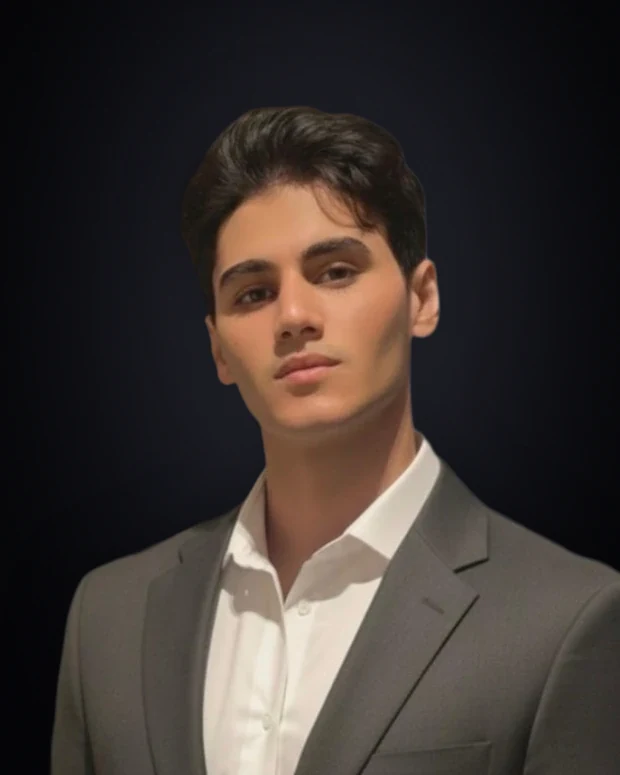
Portrait of Yousef Hossni

Yousef Hossni

Founder & Lead AI ArchitectNeusora

Yousef designs Neusora’s intelligence end to end — from the retrieval pipelines and the privacy layer to the verification behind every answer.

He architected and deployed both of Neusora’s production models, N1 and Veritas. He is also a published AI researcher: his work on deep learning for wearable-sensor and multimodal data appears in Scientific Reports, where he is corresponding author, and in Springer Nature proceedings as first author.

Research taught me that a claim is only as strong as its evidence. Every Neusora model is built to that standard: grounded, verified and private.
Research & Recognition
Scientific Reports2025
56+
Citations
Corresponding author
Springer Nature2026
99.78%
Accuracy and F1-score
First author · Opportunity benchmark
AI HackathonSolo entry
1st
Prize
Against 20+ competing teams
NeusoraLive
2
Production AI models
N1 · Veritas · architected end to end
  1. Jan 2024Research beginsDeep learning for wearable-sensor and multimodal data, from his second year of engineering.
  2. Feb 20241st PrizeAl Mulla Exchange AI Hackathon, as a solo entrant against 20+ teams.
  3. Nov 2024Embassy R&DAn edge-AI prototype, co-presented to the Hungarian Ambassador.
  4. Jan 2025Scientific ReportsCorresponding author of a KFAS-funded study on attention-based deep learning for activity recognition.
  5. May 2025Neusora foundedThe same month, presents his research at the S4IoT’25 symposium.
  6. Feb 2026Springer NatureFirst author: a multi-head attention CNN reaching 99.78% on the Opportunity benchmark.
  7. TodayN1 and Veritas liveBoth production models, architected end to end. Engineering degree completed in 2026.

Peer-reviewed,
and verifiable.

Yousef’s published research applies attention-based deep learning to wearable and multimodal sensor data, recognizing human activity with up to 99.78% accuracy. Each paper links to its permanent record.

  1. 2026
    Springer Nature · S4IoT’25 Proceedings · First author · Oral presentation

    Activity Recognition Using a Multi-head Convolution Neural Network Integrated with Attention Mechanism

    Yousef Hossni and Murad Khan. A four-pathway convolutional network with attention reaches 99.78% test accuracy and F1-score on the Opportunity multimodal sensor benchmark. Presented in person at the IEEE–Springer S4IoT’25 symposium, May 2025. Lecture Notes in Electrical Engineering, vol. 1513.

  2. 2025
    Scientific Reports · Nature Portfolio · Corresponding author

    A comparative analysis of LSTM models aided with attention and squeeze and excitation blocks for activity recognition

    Murad Khan and Yousef Hossni. Scientific Reports 15, 3858 (2025). Yousef ran every simulation and analysis in the study and built its deep-learning pipelines. Its open-access publication was funded on merit by the Kuwait Foundation for the Advancement of Sciences, and the audited simulation code is public. Cited 56+ times.

Every layer of Neusora,
architected end to end.

Neusora’s two production models, N1 and Veritas, run on an architecture Yousef designed and built himself — from the first document ingested to the last answer delivered.

01 · Knowledge

Retrieval at scale

Pipelines that turn large volumes of unstructured material — PDFs, Word files, images, audio, video and scanned pages — into embedded, searchable knowledge, now scaling to millions of retrieval chunks.

02 · Privacy

A privacy layer in front of every model

Fourteen categories of personal and health data, plus each organization’s proprietary terms, masked before any query reaches a model; per-client vaults so nothing is shared between organizations.

03 · Trust

Grounding and verification

Reasoning layers that ground every answer in retrieved sources, verify cited references live, and check every calculation deterministically.

04 · Delivery

Production that stays up

Channel-native deployment with automatic retries and exponential back-off, so organizations reach their model where their people already work — around the clock.

Built fast,
and built to be checked.

Before and alongside Neusora: systems that hold AI to hard evidence — telemetry, sensors and market data.

Lead architect2025–26

LogScope AI

Intelligent diagnostics for security logs

An AI platform for large-scale cybersecurity log analysis. A verification engine audits the agent’s conclusions against deterministic system telemetry before anything is shown, and a deterministic-to-neural pipeline parses very large log files entirely in the browser, so the raw logs never leave the machine.

  • Anomaly Galaxy — 3D clustering of outliers
  • Forensic Hunter — vulnerability and attack detection
  • Chrono-Heatmap — spikes over time
Hungarian Embassy R&DNov 2024

Edge-AI plant diagnostics

Built in an 11-day sprint

A proof of concept pairing edge hardware with computer vision for round-the-clock, autonomous monitoring of plant disease, with causal machine-learning logic that maps a disease’s cause and forecasts recovery.

  • Co-presented to the Hungarian Ambassador with the principal investigator
  • Supported the first phase of a bilateral funding grant
1st PrizeFeb 2024

Currency-exchange forecasting

Al Mulla Exchange AI Hackathon

A time-series model forecasting currency exchange rates, built alone in a four-day hackathon — data ingestion, model design, interface and the final pitch.

  • First place as a solo entrant
  • Against 20+ teams of four

From research
to production.

The range his work covers — from designing experiments and models to running them for organizations that depend on them every day.

Language-model systems

  • Retrieval-augmented generation
  • Embeddings and vector search
  • Fine-tuning (SFT, PEFT / LoRA)
  • Multilingual NLP, English and Arabic

Trust and privacy

  • Personal-data redaction
  • Per-client data isolation
  • Deterministic verification
  • Evaluation and benchmarking

Deep learning

  • CNNs, LSTMs and attention
  • Squeeze-and-excitation blocks
  • Multimodal sensor fusion
  • Anomaly detection

Computer vision and edge AI

  • Image-based diagnostics
  • Edge-hardware prototyping
  • Causal machine-learning logic
  • Time-series forecasting

Production engineering

  • Multimodal ingestion and OCR
  • Channel-native deployment
  • Resilient, self-retrying services
  • Cloud, container and edge deployment

Research practice

  • Experimental design and simulation
  • Comparative model benchmarking
  • Peer review as corresponding author
  • Scientific writing

The record.

Degree, honors and the programs behind the work, in order of weight.

Education

Bachelor of Engineering
in Computer Engineering

ABET-accredited program · 240 ECTS equivalent · 2026

A grades in Artificial Intelligence, Machine Learning and the senior design project. He began leading published AI research in his second year, aged 19.

LanguagesEnglishArabic
  1. 2025
    Competitive open-access fundingKuwait Foundation for the Advancement of Sciences · awarded on the merit of the research
  2. 2025
    Published author and oral presenterS4IoT’25 symposium · IEEE and Springer Nature
  3. 2024
    1st Prize, solo entryAl Mulla Exchange AI Hackathon · against 20+ teams of four
  4. 2024
    Presentation to the Hungarian AmbassadorEdge-AI prototype · Hungarian Embassy R&D collaboration
  5. 2024
    Selected for a fully funded exchange cohortChinese language and culture · Dalian University of Foreign Languages, China
  6. 2023
    GHABGATHON innovation competitionCompetitor · in partnership with the Kuwait Foundation for the Advancement of Sciences
  7. 2025–26
    Head Start and Steer Your CareerAdvanced training programs · INJAZ Kuwait
  8. 2022
    Android applications bootcampSix-week intensive · Kuwait Codes (CODED)

Talk to
Yousef directly.

For research collaboration, partnerships, speaking or a Neusora engagement.